
Beyond Transitional Style: What Makes a Home Feel Timeless?
SERIES #01, ARTICLE #06
I love a useful label…that is, until it starts designing the room for us.
“Transitional” usually describes a space somewhere between traditional and modern. It is helpful when explaining a design quickly, but it can also become a formula. Add wall paneling, contemporary furniture, neutral colors, and a little brass. Suddenly, the room is called timeless. Don’t get me wrong. I absolutely love the transitional style (that should be evidently clear). But everything is about balance. The individual pieces may all be beautiful, but combining certain styles does not automatically create something lasting.
Don’t split the room into “traditional” and “modern” pieces
A traditional shell with contemporary furniture can still feel disconnected. Look for shared proportions, shapes, or tones that make the pieces relate to one another.Repeat relationships, not a style checklist
Instead of automatically adding paneling, brass, oak, and neutral upholstery, repeat a few intentional ideas throughout the home; a curve, a material, a finish, or a certain visual weight.Choose what belongs to this house and the owners
Timeless rooms often feel specific rather than generic. Keep the strange beam, design around an unusual opening, display something personal, or make a custom intervention that could only make sense in that particular home.
New details should make sense beside older ones. Materials should suit the scale of the house. The layout should support how people actually live. Most importantly, the home should feel specific to its owners rather than carefully assembled to represent a category. Some elements lean traditional. Others are clearly contemporary. They work together because they share a sense of proportion, material depth, and intention.
Timelessness comes from relationships.
That sense of belonging matters more to me than whether a room can be classified perfectly. Perhaps that is partly because I already spend enough time trying to organize every thought, object, and possible outcome in my own life. A home does not need that kind of pressure too.
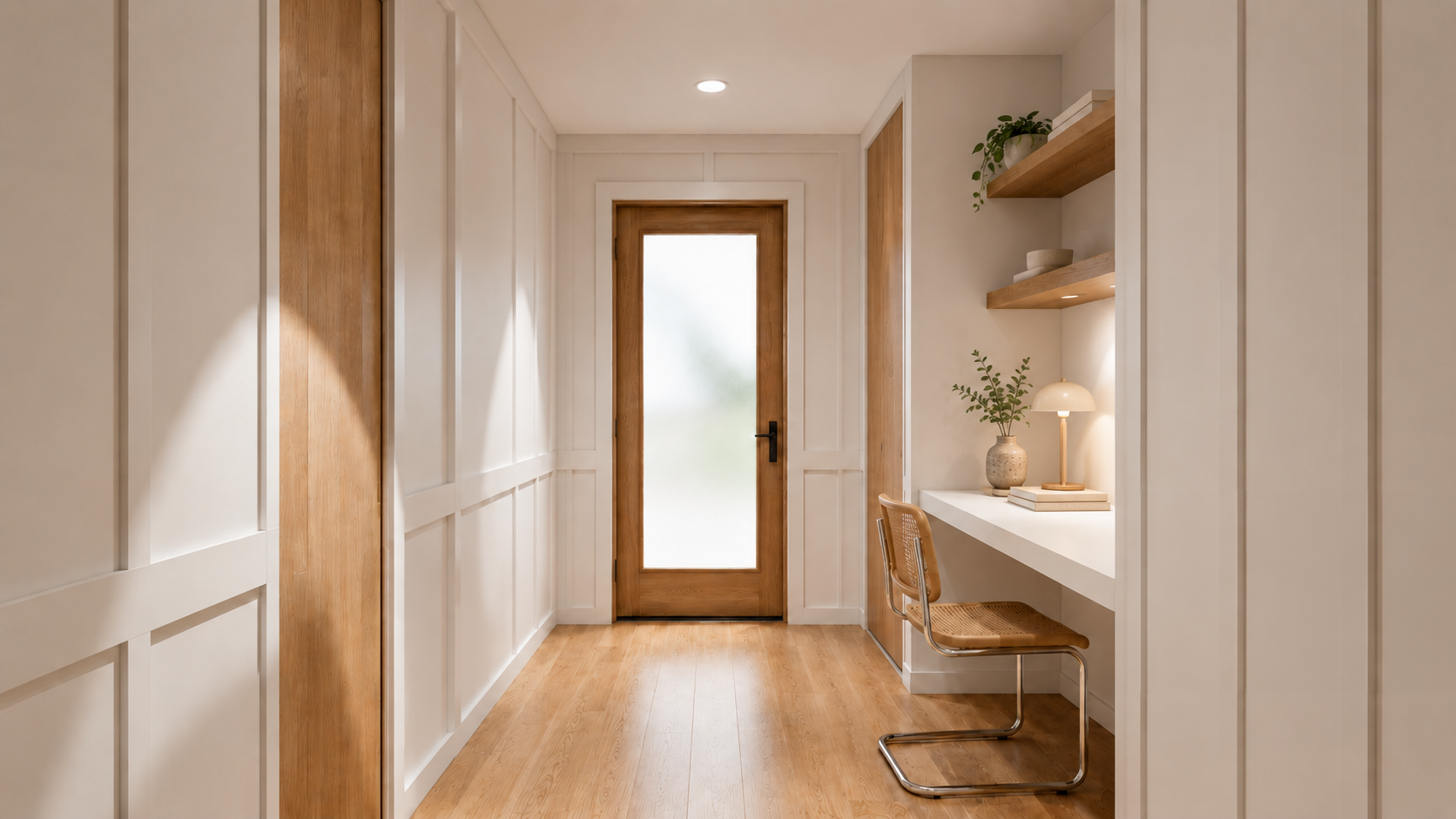
Our Holly Park Residence began as a traditional San Francisco home that needed to work differently. A custom staircase improved circulation and strengthened the connection between floors. The former garage arrival became a welcoming foyer with a bathroom and additional storage. A home office was integrated into the plan, while the kitchen was simplified without removing its expressive wood beams. Natural oak, warm white paneling, black metal balusters, handcrafted green tile, brass fixtures, and tailored millwork create a consistent language throughout the home. Holly Park sits within the broader Bernal Heights area, where modest older houses have been adapted across generations as families and daily routines changed. That continued evolution is part of the neighborhood’s character. These homes survive because people keep finding new ways to live in them. The staircase reflects that idea. The intention was not to preserve an outdated condition or insert a dramatic modern object that ignored the rest of the house. White oak treads and handrails bring warmth. Black balusters give the form clarity. Full height paneling connects the new intervention to the surrounding rooms. The staircase is visibly new, but it belongs.
It needs clarity, but it also needs enough freedom to evolve.
A room does not become timeless by avoiding every trend. That is nearly impossible anyway. Even the most enduring interiors reveal when they were designed. What helps them age well is a stronger foundation: thoughtful proportions, durable materials, useful spaces, and a point of view that is not dependent on one fashionable finish.
I think of transitional design less as a final style and more as a conversation.
Traditional architecture brings memory, craft, and permanence. Modern design brings clarity, flexibility, and a more direct response to contemporary life. The goal is not to divide the room evenly between the two, as though every modern chair requires one traditional molding in return. The goal is to make each decision feel connected to the next.
A timeless home is not one that escapes its era. It is one that keeps making sense as life changes around it.
