
What Makes a Modern Interior Feel Cold?
SERIES #01, ARTICLE #02
A modern interior rarely feels cold because it’s white. It’s cold when nothing in it needs you there.
To be blunt, let’s talk about what to AVOID and the psychology behind it. Conceptually, the blocks of modern design can be great. White can feel soft, reflective, quiet, or dramatic. Black metal can feel elegant rather than severe. Stone can feel deeply natural. What’s wrong with that? The problem is when every choice begins to have the same visual temperature (painted white cabinetry, white countertop, glossy tile, bright overhead lighting, sharp furniture, etc). None of those decisions is necessarily wrong on its own. Stacking too many together, though, they can make a space feel more like a display model than a home. We want to avoid these same emotional temperatures:
Too neutral
Cool white cabinetry, white quartz, gray upholstery, and bright lighting can flatten together without warmer materials or tones. The opposite holds true as well. Black can add definition, but repeated everywhere it starts to feel like a graphic motif rather than part of a home.No visible grain, weave, patina, or imperfection
Too many hard and reflected surfaces ends up muting the rooms language (polished stone, glossy tile, lacquer, glass, metal, smooth drywall, flat cabinets, etc). Texture is often what turns minimalism from sterile into calmingToo many sharp lines and rigid forms
Modernism already favors clean geometry. Rectilinear furniture, square lighting, and crisp millwork benefit from something softer, rounded, irregular, or handmade.Removing every sign of personality or age
Perfectly matched furniture and completely cleared surfaces can make a room feel staged. A home feels richer when it includes objects, materials, and pieces that appear collected over time.
To clarify, the goal isn’t really to make a modern home less modern. It’s to introduce contrast: warm against cool, matte against polished, soft against sharp, old against new.
Those small tensions are what make a room feel human. It’s sensory and psychological contrast.
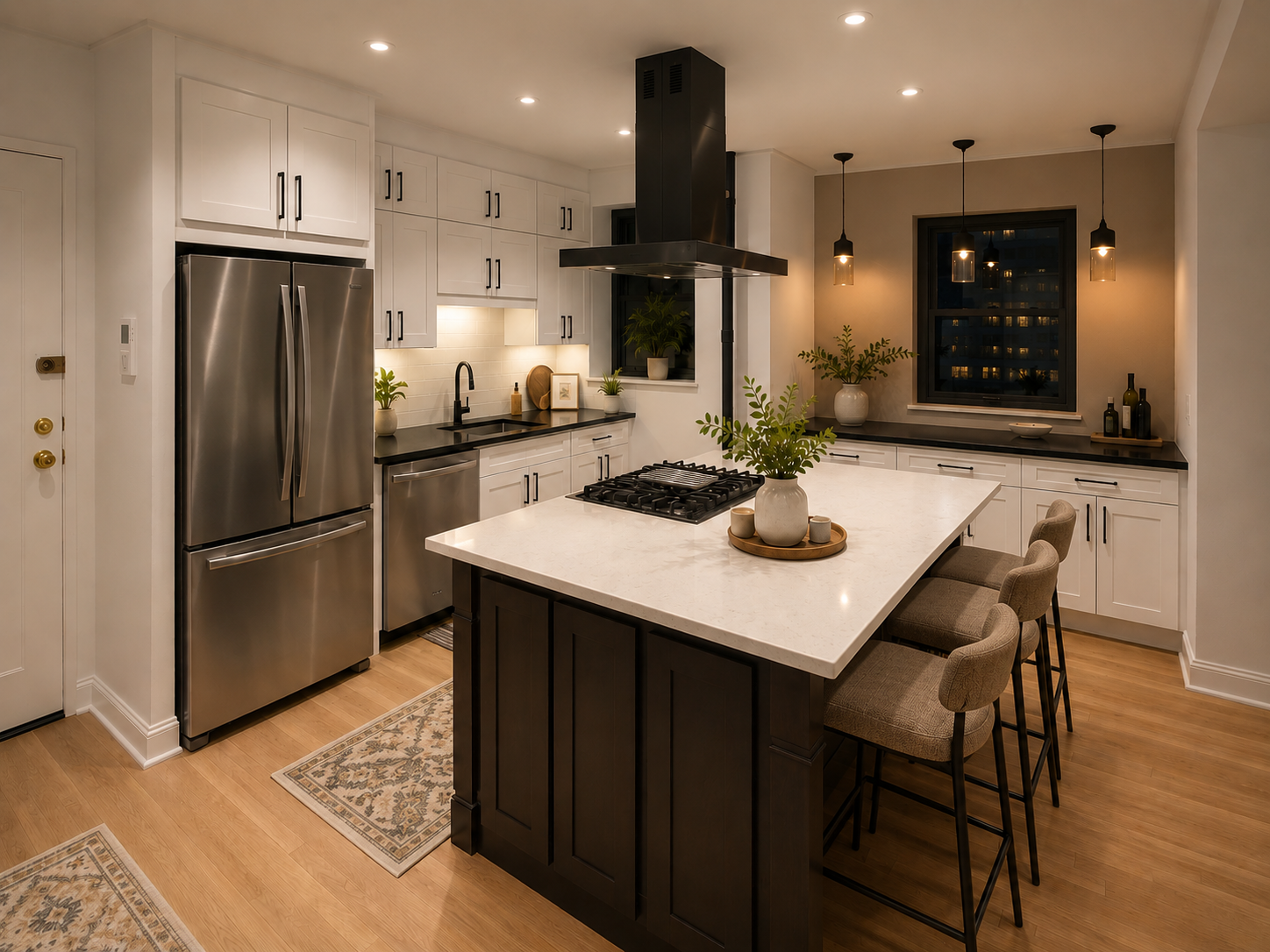
For our Jackson Heights condo renovation, we used a predominantly white palette but balanced it with movement, contrast, and warmth. Tessuto White tile gives the kitchen walls a subtle texture. Matte black details define the hood and fixtures, while warm oak flooring continues into the living space. Neutral upholstery and wood accents soften the transition between the two. The enlarged island is clean and contemporary, but it is also the social center of the room. It creates a place to gather, eat, work, or talk while someone cooks (usually all four at once, because that is how people actually live). That sense of daily life feels especially relevant in Jackson Heights. The neighborhood is known for its early garden apartments, designed around light, air, landscaping, and shared courtyards. These buildings offered an alternative to the darker, denser urban block. Openness was never meant to be only visual. It was meant to make living feel better.
An open floor plan still needs intimacy.
A large empty room may photograph beautifully, but it can feel strangely uncomfortable when there is nowhere obvious to sit or pause. Here, the island anchors the kitchen, while the rug, seating, and cabinetry create a more intimate living zone. The spaces remain connected without dissolving into one undefined room. Lighting changes the atmosphere just as much as furniture does. A ceiling filled with bright recessed fixtures may illuminate everything, but even lighting is not always inviting lighting.
Incoming side tangent: When designing the location for recessed lighting in the ceiling, the usual practice is to space them equally. We typically want each source to spread evenly to avoid overlap or empty spots in terms of the foot candles (light intensity). Here’s the twist. It’s practical and usually the correct layout, but it can also make a space feel flat and ultimately cold. Supplementary light sources is usually why we add them in design to add back that sense of rhythm and variation that creates warmth: sconces, floor lamps, pendants, recessed LED strips, etc.
A simple candle achieves impactful variation, since it translates light as a volumetric space with movement.
A comfortable home needs variation: focused light for cooking, softer light in the evening, and natural light that changes throughout the day. Texture gives that light somewhere to land. The movement of the tile, the grain of the oak, and the softness of fabric create depth without adding clutter.
Modern design feels cold when perfection becomes more important than comfort. The answer is not to fill every surface, but to leave enough contrast, softness, and shadow for daily life to belong there.
A home should not feel untouched. It should make you want to stay.
