
Which Traditional Details Are Worth Preserving?
SERIES #01, ARTICLE #05
The most valuable historic detail is not always the most decorative one.
Preservation is less about keeping everything and more about understanding which elements give a home its identity. A favorite saying I learned in school way back when (I’m older than I look) is, “Listen to the material.” It means having a metaphysical dialogue with the material and asking what it wants to be, or how it wants to be treated.
I think that core motto still informs how I design now and how I make decisions within a space. A detail is usually worth preserving when it contributes to proportion, craftsmanship, material character, or a sense of place. It should tell us something about the home that would be difficult to recreate once it is gone.
Preserve proportion, not just ornament
Framed openings, ceiling heights, wall divisions, and room proportions often shape the character of a historic home more than decorative trim does.Keep materials that are difficult to reproduce
Original herringbone floors, solid wood doors, plasterwork, or custom millwork carry depth, craftsmanship, and age that new replacements rarely match.Let new interventions remain clearly contemporary
Black-framed glass doors, integrated appliances, updated lighting, and new storage can improve daily life without pretending to be original. The contrast allows both old and new to read more clearly.
At our Midtown prewar condo renovation, that meant retaining the apartment’s herringbone floors, framed openings, wall paneling, and tailored millwork. Contemporary lighting (tray ceilings), black framed glass doors, integrated appliances, updated storage, and warm furnishings allow those details to belong to present day life.
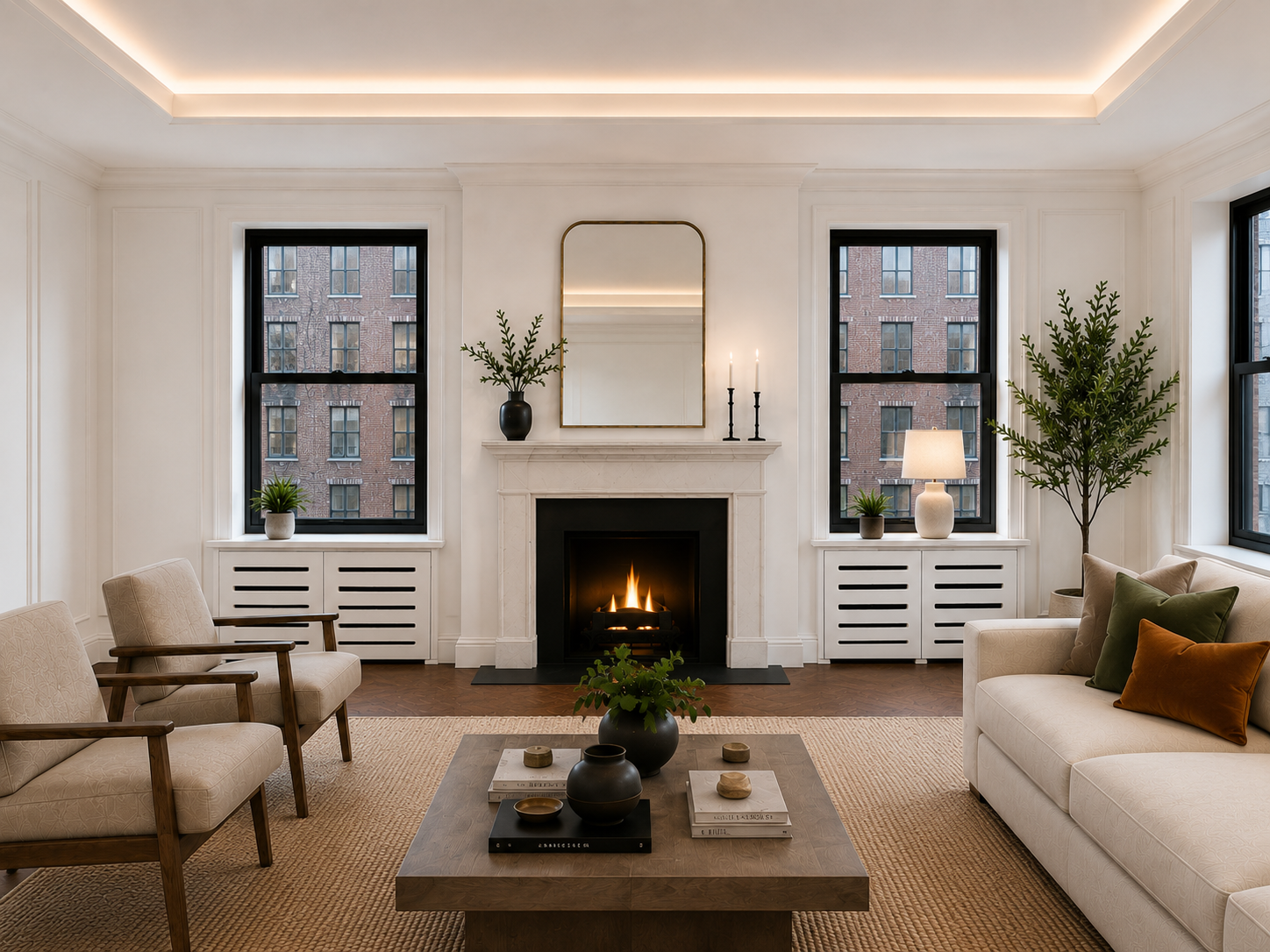
The Park Avenue corridor evolved from a boulevard of private houses into one lined with substantial apartment buildings. Many early twentieth century residences borrowed the formality of townhouses, with carefully composed rooms, gracious proportions, decorative trim, and a strong sense of arrival. Ceiling height, window scale, doorway placement, and the sequence between rooms create a sense of order even after finishes have changed. Preserving that underlying structure can be more meaningful than introducing new decoration intended to look historic.
Inside these apartments, proportion often matters more than ornament.
Wood floors often carry similar weight. Their pattern and variation influence the character of an entire room. When repair is possible, an existing herringbone floor usually offers a depth that is difficult to reproduce with something chosen simply because it looks old. Millwork requires more judgment. Well proportioned paneling, built-ins, trim, and doors can establish scale and rhythm. Poor reproductions can make a room feel heavy or overly formal. In the Midtown residence, millwork is used selectively to reinforce the architecture while concealing storage, integrating lighting, and turning an underused alcove into a reading nook. Fireplaces, hardware, tile, and plumbing fixtures deserve the same careful evaluation. A beautiful feature that no longer functions safely may need to be repaired or adapted. An original door with unusual proportions may matter far more than a generic molding added during a later renovation.
I often think about preservation in terms of emotional weight.
What would make the apartment feel strangely anonymous if it disappeared? What tells you something about the building before anyone explains its history? What feels worn in a way that reveals care, use, and time rather than simple neglect? The strongest renovations may preserve fewer elements than expected, but they preserve the ones that matter. Once the essential proportions, materials, and rhythms are understood, the new work can be introduced with greater clarity. Those are often the details worth fighting for.
Preservation is not about keeping everything. It is about knowing what the home would no longer be itself without.
