
How to Modernize a Traditional Home Without Losing Its Character
SERIES #01, ARTICLE #04
A traditional home should not have to forget itself to work for modern life.
Older homes are rarely difficult to love. However, they can be much more difficult to live in. The kitchen may be isolated. Storage may be limited. Rooms may feel dark, and decades of smaller renovations may have left behind an awkward collection of finishes. Yet removing everything in the name of modernization can erase the exact qualities that made the home special.
Keep the architectural bones, update the function
Preserve original moldings, fireplaces, stair details, or room proportions while improving kitchens, baths, storage, lighting, and circulation around them.Repair and reveal before replacing
Refinish old wood floors, uncover brick, restore doors, or repair plaster where possible. Age and imperfection often carry more character than a new substitute.Use new materials that converse with the old
Contemporary cabinetry, stone, tile, and lighting can feel fresh without competing with the house when their scale, color, and materiality respond to what is already there.
The challenge is deciding what should change and what the house is quietly asking you to keep.
We approached our Bedford Stuyvesant brownstone as an evolution rather than a reset. Original woodwork, herringbone floors, brick fireplaces, and traditional room proportions form the architectural foundation. Sage cabinetry, marble surfaces, brass fixtures, geometric tile, and custom built-ins bring the house into contemporary life.
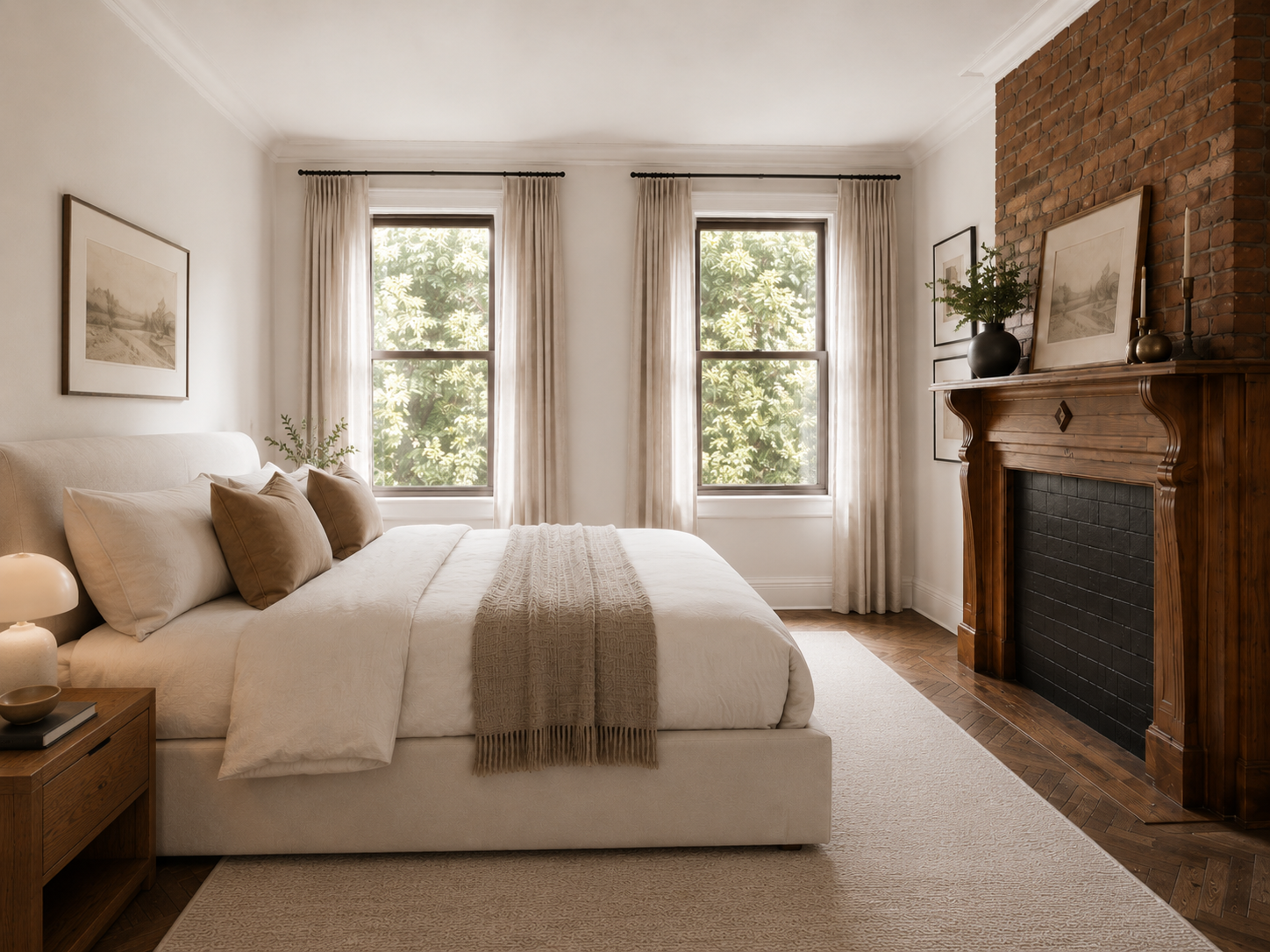
Bedford Stuyvesant is defined by long rows of nineteenth-century brownstone and brick homes. Their character comes not only from carved facades and ironwork, but from the experience of moving through them: tall openings, fireplaces, wood floors, and rooms that unfold one after another. Modern families often want more connection between those spaces. That does not mean every wall should disappear. Sometimes an opening can be widened rather than removed. A doorway can frame a view into the next room. A kitchen can become more social while the home retains its sense of progression. Those shifts between enclosed and open spaces are part of what makes a traditional house feel different from a new open-plan apartment. Removing them all may create more space, but it can also make the home less memorable.
In this project, the new cabinetry does not attempt to imitate the original millwork. Its sage finish makes it clear that the kitchen belongs to the present. The proportions still feel architectural, while brass connects naturally with the warmth of the existing wood. Marble brightens the room without making it feel overly sleek, and custom built-ins give the fireplace wall renewed purpose.
Instead of asking, “How do we make this look modern?” I prefer to ask, “How should this home function now?”
That question changes the priorities. Circulation improves. Storage is placed where it is actually needed. The kitchen becomes part of daily life rather than a room hidden behind it. Modernization becomes a response to how people live, not a style applied over the building.
Of course, not every old feature is precious. Some details may be damaged, poorly made, or left behind by a renovation that never understood the original house. Preservation should be thoughtful, not automatic. Old does not always mean good. The goal is to identify which elements are carrying the home’s character, then allow the new work to support them rather than compete with them.
The best renovation does not trap a house in the past. It leaves the past visible and makes the present feel at home.
